
Transaction log issues are one of the quietest ways a healthy database turns into an incident. A log file fills up, backups fall behind, and by the time anyone notices it is a 2am page rather than a five-minute fix. AgentDBA runs against SQL Server and explains, in plain language, what is wrong and what to do about it. Below is a real example of it catching one.
Read more: Resolving SQL Server Transaction Log Issues EfficientlyThe check
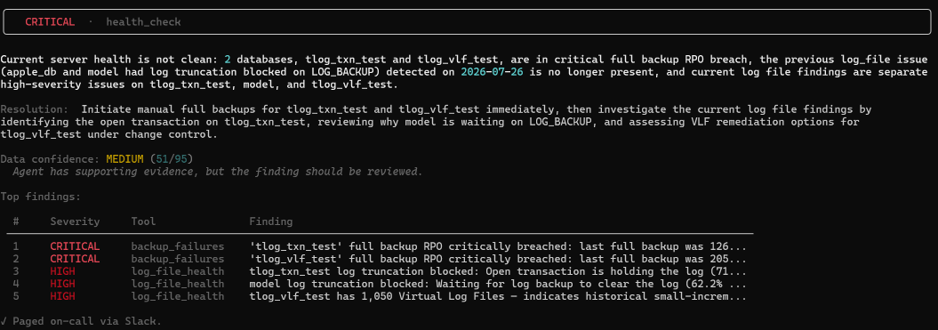
A routine full server check comes back CRITICAL. Two databases have blown through their backup RPO entirely (recovery point objective — how much data would be lost if a restore were needed right now), and three have separate high-severity transaction log problems. Instead of a wall of undifferentiated alerts, AgentDBA groups the findings, ranks them by severity, and attaches a confidence score (51/95, “has supporting evidence, but should be reviewed”) so the DBA knows exactly how much to trust the read before acting on it.
Following the evidence
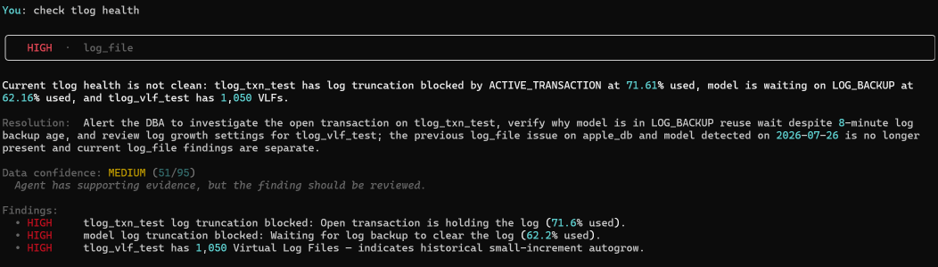
A quick follow-up question, “check tlog health,” drills straight into the detail: tlog_txn_test has an open transaction holding the log at 71.6% used, model is stuck waiting on a log backup, and tlog_vlf_test has 1,050 virtual log files — a telltale sign of small autogrow increments rather than a properly sized log. Each finding comes with a plain-English resolution, not just a symptom.
None of this is a guess. It is grounded in the same data a DBA would pull by hand — here, the log_reuse_wait_desc column straight from sys.databases, confirming the active transaction and the pending log backup wait.
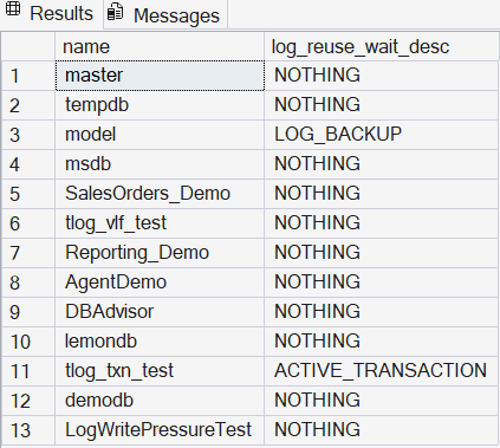
Underlying evidence — verified directly against SQL Server, not inferred.
Connecting the dots
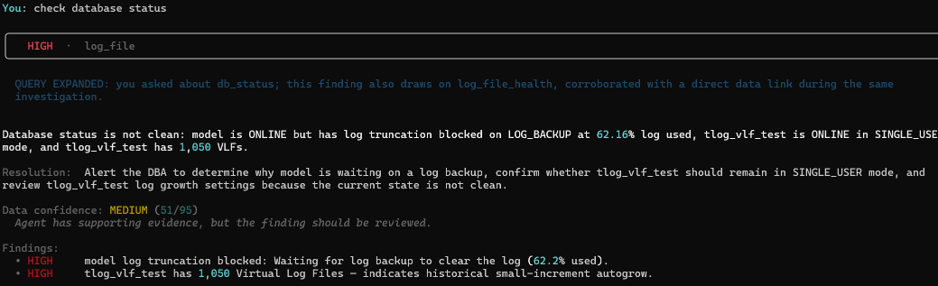
It also does this unprompted. Asking a separate question, “check database status,” pulls back the same underlying finding and says so explicitly: “you asked about db_status; this finding also draws on log_file_health, corroborated with a direct data link during the same investigation.”
Rather than treating each question as a fresh, isolated lookup, it recognises the two are related and merges the evidence — so the DBA gets one coherent picture instead of having to cross reference two separate answers themselves.
Why this matters for DBAs
- Time back: what is normally a 15–20 minute manual triage — checking sys.databases, log_reuse_wait_desc, VLF counts, and backup history separately — becomes a single question with a direct answer.
- Trust, not blind faith: every finding ships with a confidence score and the underlying evidence, so the DBA can see why the agent believes what it believes rather than taking it on faith.
- Connected context: findings link together across questions instead of resetting with every check, as shown above.

